These discussions took place when UWC, the World Council of Churches's (WCC) Commission on World Mission and Evangelism and its Programme for Overcoming Racism, Xenophobia and Related Discrimination hosted a pivotal seminar titled "Decolonising the Bible in the Midst of Colonial Legacies and Idolatrous Powers". The week-long event, held from 19 to 22 November 2024, attracted attendees worldwide. Participants engaged in critical discussions on the Bible's influence in colonial and post-colonial contexts, its historical usage in oppressive systems, and its enduring potential to foster justice and liberation.
The seminar aligned with UWC and WCC's shared commitment to exploring fresh approaches to decolonisation and addressing theological paradigms that respond to contemporary global crises. These include climate change, systemic oppression, and the enduring legacy of colonial ideologies.
The week's discussions highlighted how the Bible has historically been weaponised to entrench systems of power while also holding the potential for liberation and justice. Prof Ignatius Swart, Head of the Department of Religion and Theology at UWC, remarked: "The Bible, as both text and symbol, has played an undeniable role in shaping colonial and neo-colonial systems. Yet, it also carries the seeds of liberation theology and transformative justice within it. This seminar invites us to critically examine how we engage with the Bible to challenge the systemic logic of empire that persists in our world."
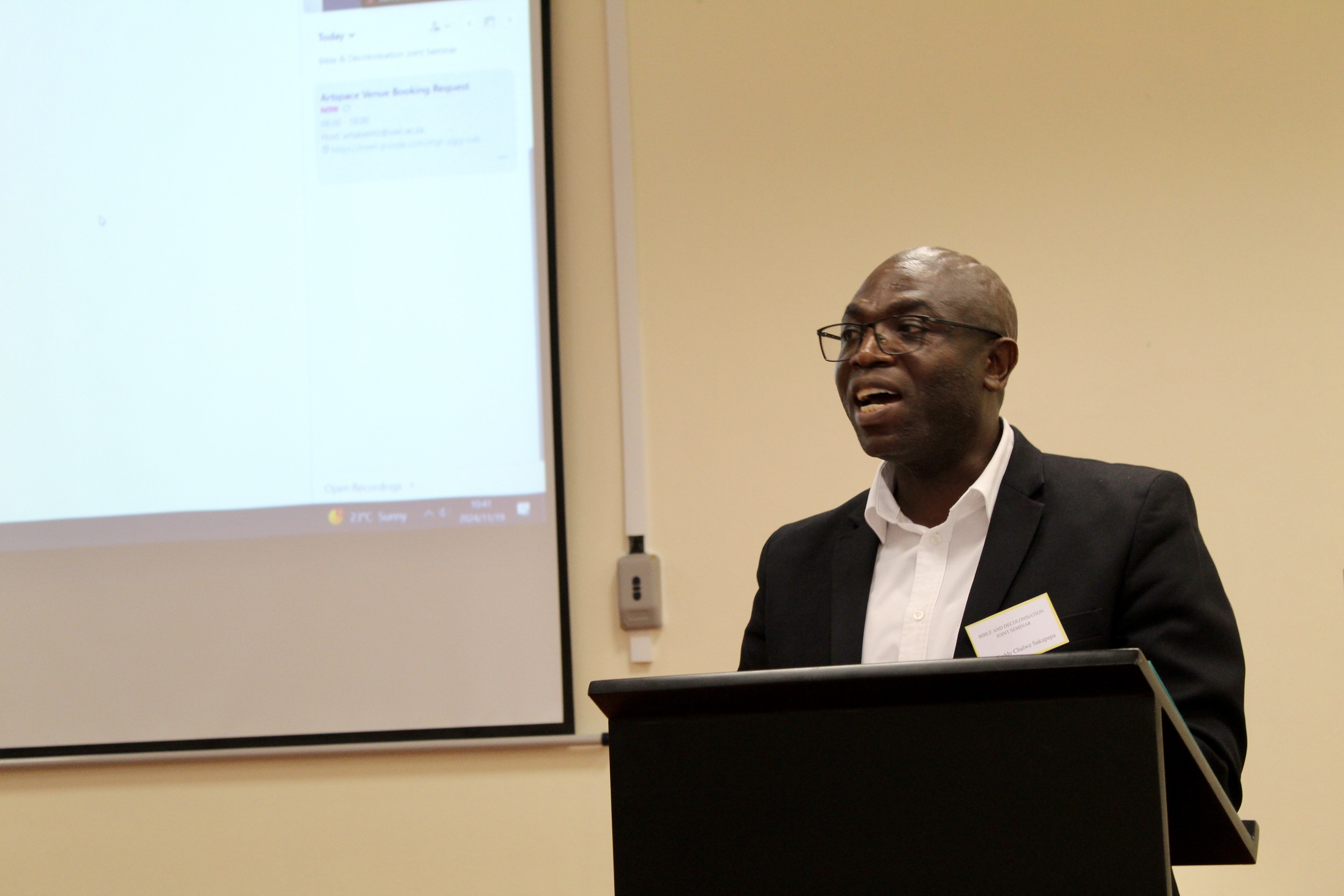
He added that Cape Town was an ideal destination for the event as participants also visited significant historic places that reflect the entanglement of religion, colonialism, and economic subjugation famed as the unholy trinity.
Furthermore, he said the seminar has incisive implications for the work at UWC in rethinking pedagogy in the study of religion and theology. The outcomes of the seminar, Dr Sakupapa added, “hold significance for ecumenical theological education at UWC, and for transdisciplinary work and resistance against the powers of our time. The seminar pointedly called for decolonial imagination and praxis critiquing abstract commitments to decolonisation. Decolonisation demands embodied performance of resistance. It has implications for how we think and act the decolonial.”
Dr Masiiwa Gunda is a programme executive with the WCC working on overcoming racism, xenophobia and related discrimination "What stood out for me is the call for mainstreaming of racial justice approaches in university curriculum. And how we distill this curriculum to reach the grassroots. Universities are obligated to engage students and work with grassroots communities to distill these ideas into actionable practices," said Dr Gunda.
Dr Peter Cruchley, Director of the Commission for World Mission and Evangelism in the WCC, added his voice on the historical entanglement of mission work with colonialism: "Mission has been historically, and still is, a deeply colonial force and presence in our communities and on the land. This event has profoundly exposed this again, as we have heard from scholars and activists. It rekindles our desire to frame Mission in ways that confront this history and make reparations. We are deeply grateful for this space to reflect and grow."
Adding a personal perspective, final-year theology student Lee-Anne Munro said the seminar demonstrated how much the discussion of decoloniality and the Bible is needed. “The immersion tour revealed how closely our present is linked with colonial history, echoing the pain caused by our ancestors and forefathers. It's clear we need to incorporate lived experiences into our academic and community spaces, and as we leave, we do so with open eyes, ready to apply what we've learned not just in studies but in our lives."
Chief Edmund Stuurman, from the Gamtouer community in the Eastern Cape and a member of the Ecumenical Indigenous Peoples Network, emphasised the importance of healing: "For me, it's important that communities deal with the trauma and hurt of the past. Beneficiaries and victims of these legacies must unite with organisations like the WCC to forge new pathways. Only then can we look at the world through a decolonised lens."