Over the years, Writing Centre staff have also engaged in scholarship of teaching and learning and professional development, and have collaborated with academics to assist them with developing the academic literacies of students within their own teaching and curricula.
As part of its 30th anniversary celebration, the Writing Centre hosted a day-long Academic Literacies colloquium on 18 October 2024.
The colloquium was well attended by approximately 65 presenters and participants, including UWC academic staff, academic literacy practitioners, postgraduate students, Graduate Lecturing Assistants (GLAs) and tutors.
There were also staff members from other areas of campus, including the Library and Institutional Planning as well as participants from other Writing Centres in the Western Cape.
The theme of the colloquium, Developing students’ academic literacies: A journey through changing times, was chosen to encourage different role players to reflect on how academic literacy development practices have evolved over time.
Presentations and interactive sessions that cut across various themes highlighted persisting challenges, as well as current and contentious issues regarding students’ academic literacies development.
Speaking about the beginnings of the Writing Centre, Arona Dison, the current Writing Centre coordinator, noted that the Writing Centre was established in 1994 by Brenda Leibowitz as a pilot project within the Academic Development Centre (ADC) at UWC.
This was in response to the massification of higher education which required universities to support students for whom English was an additional language.
Leibowitz went on to make a major contribution to learning and teaching in higher education - both within South Africa and internationally and she was a highly regarded and thoughtful scholar.
Sadly, she passed away in 2018. At the colloquium, a moving tribute was paid to Leibowitz by Susan van Schalkwyk, a colleague from Stellenbosch University.
Writing Centre tutors Natasha Makowe and Quasiema Hendricks shed light on some of the challenges that students faced in their writing, including task analysis, referencing/plagiarism, structuring essays to achieve logic and flow, and challenges linked to English language proficiency.
Much like in the 1990s, the Writing Centre today continues to help students through postgraduate tutors, who offer one-on-one or group consultations to provide feedback on writing tasks.
Supporting lecturers in developing students’ academic literacies has also been part of the Writing Centre’s work over the years.
In this regard, Dison highlighted a shift to the concept of “embedding academic literacies” in the curriculum. This was demonstrated in a session by Karen Collett, a senior lecturer in the Faculty of Education.
She shared experiences of Writing Centre tutors providing formative feedback on scaffolded tasks that culminated in a long essay, helping students to progressively improve their writing.
Karen emphasised the importance of a well-designed formative feedback strategy that is integrated into the curriculum.
Over the years, technology has significantly influenced teaching and learning practices in higher education.
“There was great excitement in the Writing Centre in the late 1990s about the donations of computers,” Dison said.
Subsequently, the Writing Centre assisted students with “word-processing” which would facilitate the drafting and redrafting of assignments.
A significant challenge then, as expressed by Andrea Parkerson, the first coordinator of the Writing Centre, was getting students to see typing on a computer as an important part of their writing and learning process, rather than as a final step.
In 2024, one of the issues that we are faced with is the challenge of undergraduate students running blindly through the fields of generative artificial intelligence (AI) and how this impacts on learning and assessment.
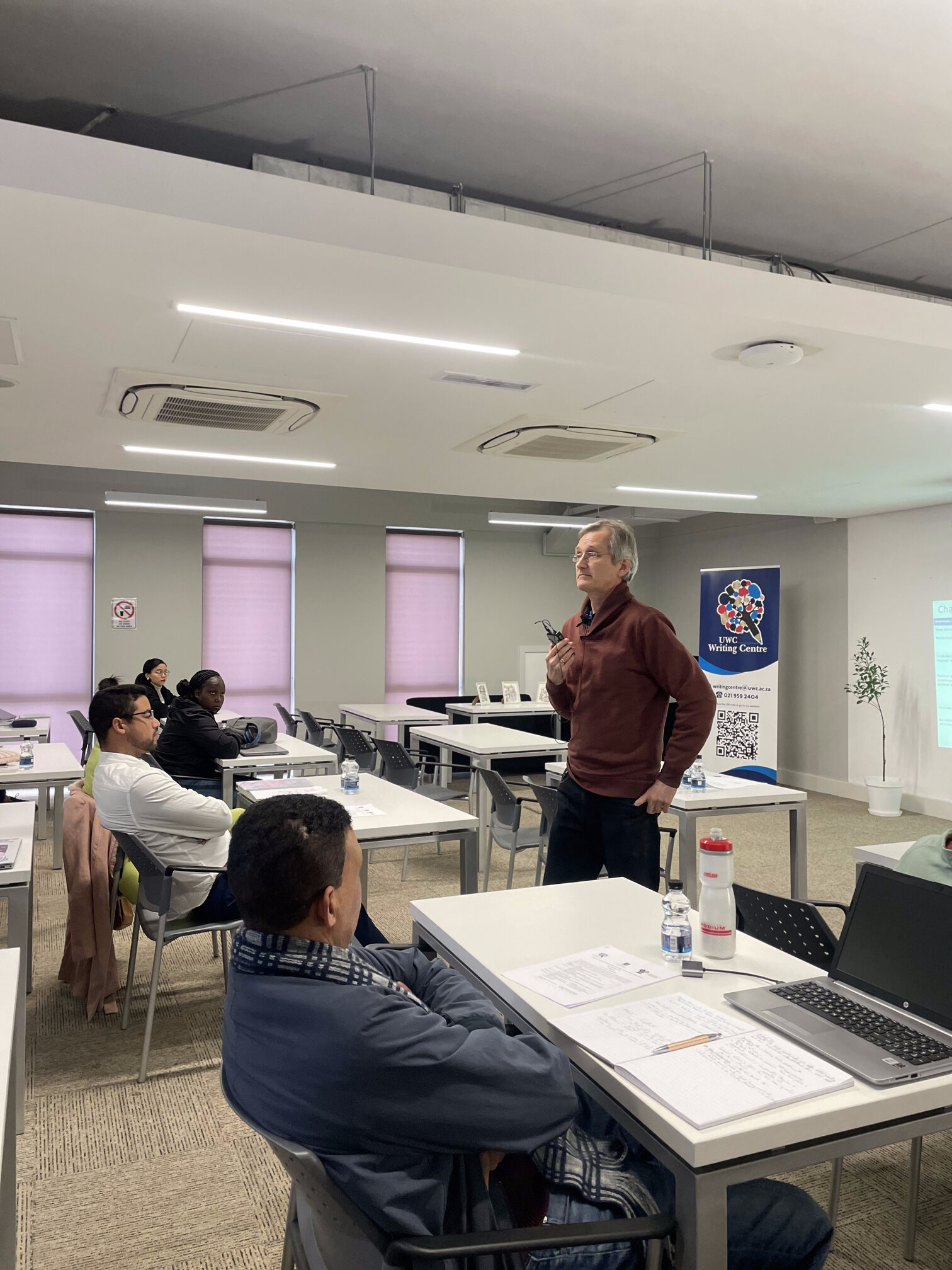
He argued that in extreme cases, AI paraphrasing tools can “improve a text almost beyond recognition. In the process, they risk distorting students' capabilities and their identities as writers”.
Plüddemann suggested that policies on AI should come both from top-down and bottom-up and that students should also be given a chance to give input on AI assessment policy.
A decolonial view of academic literacies emphasised that learners were not passive recipients of knowledge but came with their own knowledge, and should actively participate in co-creating knowledge in higher education.
Various contributors at the colloquium shared experiences of reimagining pedagogical practices through a decolonial lens.
Martina Van Heerden and her colleagues, including Honours students from the Linguistics Department, demonstrated their use of multimodal assessments in place of essays.
Students shared their creative and visual modes of expression to convey how they perceived and understood the decolonial concept of ‘locus of enunciation’, and how this affected the ways in which they ‘see’ and ‘understand’ literacy in their everyday lives.
Bronwyn Witbooi, a Master’s student in Linguistics shared her experience with implementing a tutorial lesson guide that incorporated multimodal elements.
This allowed students to create poster artefacts that use metaphorical linking, storytelling, study notes, and other embodied practices such as role-play that allow students to connect their personal lived experiences with the theoretical content.
Both presenters argued that allowing meaning to be made across multiple modes enabled students to engage with content in ways that are more accessible to them.
Bradley Rink’s interactive exercise invited colloquium participants to reflect on their mobility practices by writing about their journey to the UWC campus and then relating their experience to theory.
He explained that this approach, which he used with students in the Department of Geography, Environmental Studies and Tourism, reversed and disrupted the traditional preference for teaching theory before applying it to real-world situations, thus valuing the knowledge that students bring into the classroom.
Overall, these contributions highlighted the potential for reimagining teaching and assessment practices to improve access to knowledge and enhance learning.
The UWC Writing Centre recognises the importance of creating space for diverse forms of expression in building students’ confidence.
Thus, as part of its 30th anniversary celebrations, it organised various activities for students to express their creative talents.
One such event was the Word and Art competition, which invited students to share their writing journeys through art, elaborated on with a short narrative.
Participants Josmorine Bergstedt and Kauthar Isaacs shared their experiences with the competition at the colloquium, with Kauthar emphasising that such activities were less daunting than academic writing, and even cathartic, helping her build a positive relationship with writing. All of the Word and Art submissions were on display.
Participants at the colloquium valued the opportunity for dialogue, learning and engagement. They appreciated interacting in a shared physical space.
Many expressed the opinion that the colloquium provided a space for the development of critical communities of practice for those involved in facilitating students’ learning and development of literacies.
- Dr Arona Dison is the Coordinator of the UWC Writing Centre and Teaching & Learning Specialist in the Directorate of Learning, Teaching and Student Success.
- Dr Phoene Mesa Oware is a postdoctoral research fellow at the UWC School of Public Health and facilitates the planning of the 30th-anniversary activities at the UWC Writing Centre.