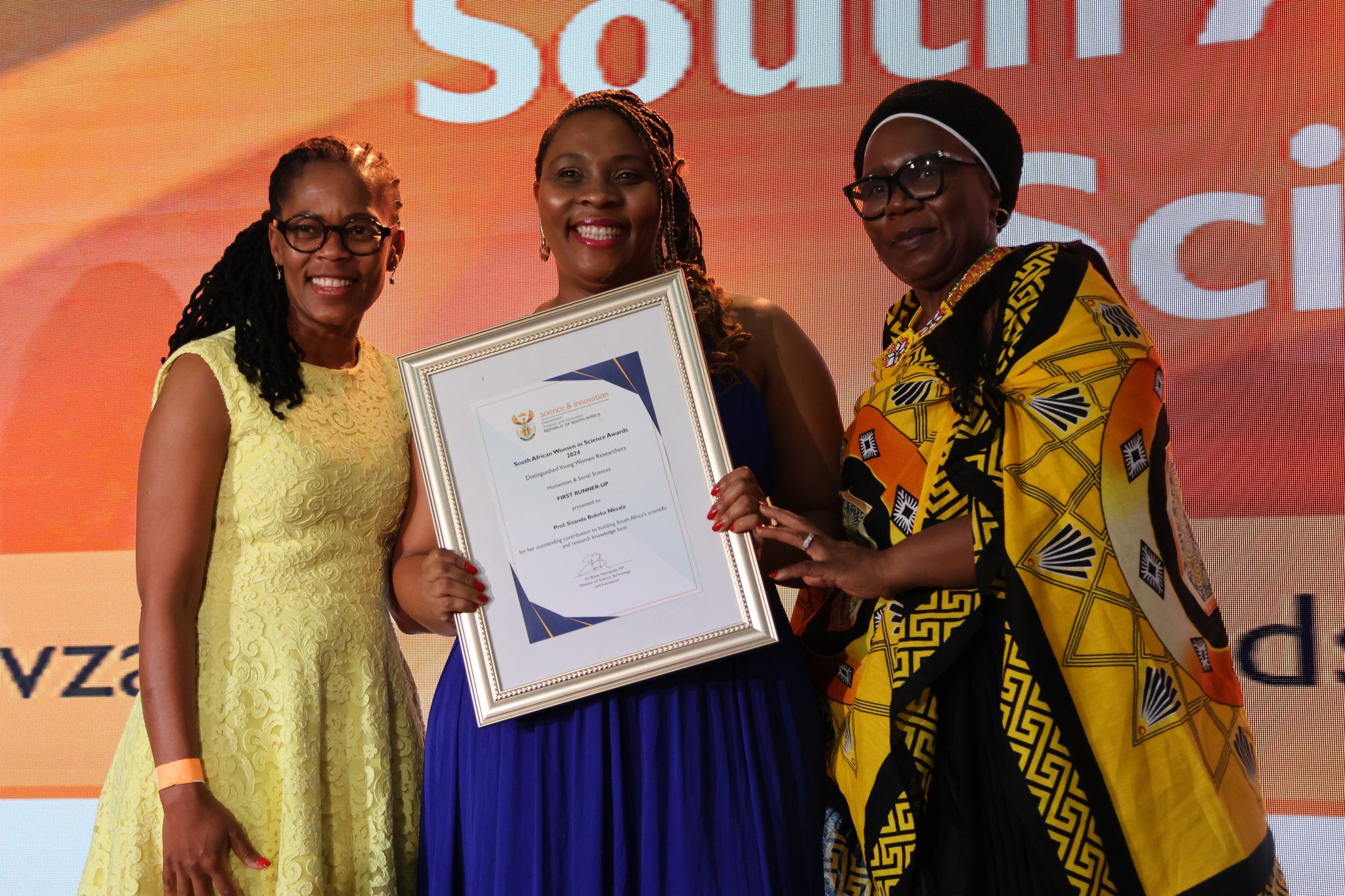
 Proefssor Sisanda Nkoala
In a world often dominated by STEM disciplines, Sisanda Nkoala, Associate Professor in the UWC Linguistics Department, is a rising star in the area of media, rhetoric and language, and whose work challenges traditional boundaries and demonstrates the importance of communication in understanding and shaping our world.
With a PhD in rhetoric studies, her research focuses on the intersection of rhetoric, media, and language and demonstrates the critical role these disciplines play in understanding and shaping our society.
Her recent recognition in two of the country’s most prestigious national research awards showcases the indispensable, innovative and invaluable contribution of the humanities and social sciences in the broader landscape of knowledge creation.
The first was the Department of Science and Innovation South African Women in Science Awards (SAWiSA), where she was first runner-up in the Distinguished Young Women Researchers in Humanities and Social Sciences category for her “outstanding contribution to building South Africa’s scientific and research knowledge base”.
The awards recognise and reward excellence by women scientists and researchers under 40 and profile them as role models for younger women.
Professor Nkoala was also awarded a prestigious NRF Research Excellence Award for Early Career/Emerging Researchers.
These awards honour the country’s leading young scientists and some of the best-performing early career researchers for excellence and achievement in knowledge creation and dissemination.
They also provide a platform for new and emerging researchers to be inspired and to experience first-hand what it takes to become a recognised scholar as part of the NRF’s transformation agenda.
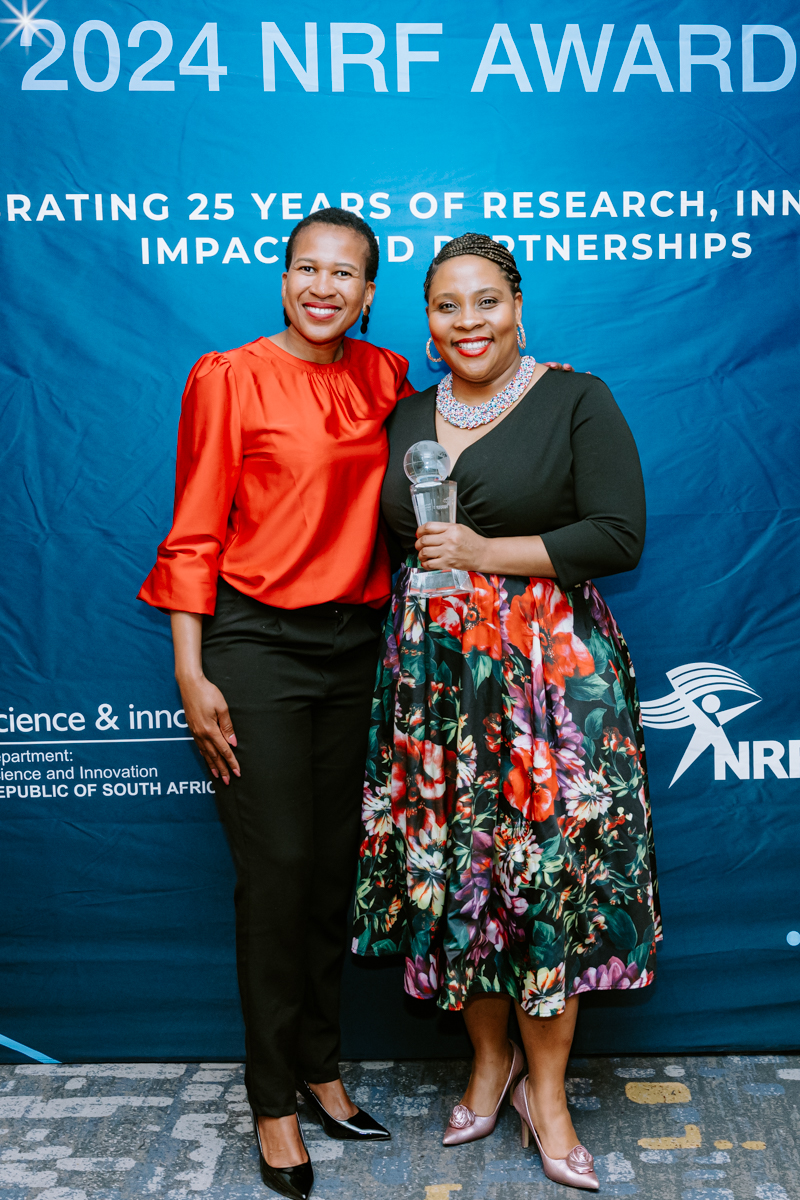
“Receiving just one of these is a career-defining milestone. To be awarded both is such an affirming honour that demonstrates that my research is not only valued within my field but also recognised for its broader contribution to knowledge and society," said Professor Nkoala.
In both of these, she received the support of the Dean of Arts and Humanities, Professor Monwabisi Ralarala, and HoD of the Linguistics Department, Professor Amiena Peck, supported her nomination for the NRF Award.
“I joined UWC in January this year and am so grateful to have walked into a faculty and department with such strong support systems for researchers, and that is carving a niche in media studies, with plans to introduce new opportunities for students to learn and research this field.”
Professor Nkoala's journey to academic success wasn't linear. Initially pursuing chemical engineering, she found her true calling in media studies.
“I have always wanted to be a scientist," she explains, "and because of my good maths and science marks in high school, I thought that meant going the traditional STEM route.”
However, an accidental introduction to media studies during her undergraduate years broadened her perspective on scientific inquiry and innovation. After working as a radio journalist, she joined academia.
Now, one of her goals is to expand the definition of 'scientist' to include those in social science fields like hers.
“I have been a full-time academic for around seven years and have been incredibly blessed by how well-received my work has been. In 2023, I was awarded the National Institute of Humanities and Social Sciences Digital Humanities Award for Best Visualisation or Infographic. I also received the HERS-SA Young Woman Leader in Higher Education in 2023. I was recognised as a 2022 Open Education Resource Champion for the South African Centre for Digital Language Resources. Further, the Western Cape Department of Cultural Affairs and Sport awarded me the 2023 Best Archival Researcher award. These latest awards are huge and hugely humbling.”
Her research is innovative and multidisciplinary, combining media, rhetoric, digital humanities, journalism education and computational methods.
From analysing the persuasive power of struggle songs to using computational social methods to examine science communication on social media, and working towards a digital archive of the Early South African Black Press, Professor Nkoala’s work bridges the gap between academia and real-world impact.
She is also a huge believer in research communication and public engagement. She has provided commentary for local and international media platforms including SABC, Newzroom Afrika, the Namibian Broadcasting Corporation and Cape Talk.
“For me, the point of science is to advance public understanding of issues and phenomena, so it is important to ensure I share my scholarship with audiences outside of academia. I am also intentional about being involved in the industry bodies that service the sector I research.”
As such, she serves as a public representative on the South African Press Council, a Council member of the South African National Editors Forum, and a member of the Appeals Tribunal of the Film and Publication Board, among others.
She also occupies leadership positions in international academic associations, including the African Journalism Educators Network, and the International Association of Media and Communication Research.

Professor Nkoala’s achievements challenge the notion that media and communication studies lack academic value. “Rhetoric, media and communication-related fields are not typically recognised in conversations about scientific inquiry and impact.
In fact, some have advanced a view that there is little use to studying these at a tertiary level, let alone doing research on them because they are not 'hard' sciences. But when bodies like the NRF and DSI recognise my scholarship in these fields, honour it as innovative and note its contribution to the country’s knowledge base, the honour is a nod to the importance of these fields in shaping our understanding of the world,” she explained.
Her message of inspiration to aspiring female scientists, particularly those in the Arts, Humanities and Social Sciences, is to “take up space and challenge the status quo. The South African and global scientific and research knowledge base needs the unique perspectives and critical insights that only these fields can bring.”