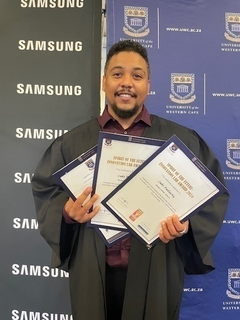
 Luke Padiachy
This perfectly captures the essence of the Future-Innovation Lab at the University of the Western Cape (UWC), a collaborative effort with Samsung to equip previously disadvantaged youth with the skills to thrive in an AI-driven economy.
The lab provides the youth with knowledge and the tools to reshape their futures—tools that can combat one of South Africa's most pressing issues: youth unemployment.
Youth unemployment remains a significant problem in South Africa, with 45.5% of the country’s young people (aged 15-34) currently without jobs. UWC’s Future-Innovation Lab, established in 2019 in partnership with Samsung, was designed with this challenge in mind.
A 10-month foundational software development programme aims to bridge the gap between education and industry by providing the technical skills and social innovation experiences that open doors to employment, further training, and pathways into industry networks.
The programme's fourth cohort graduated on October 8, 2024, as a beacon of hope for previously disadvantaged young people seeking to enter the competitive software development sector.
Lenhle Khoza, Manager for B-BBEE and Transformation at Samsung South Africa, emphasised the initiative's broader vision: “Our focus has been on capacity building in ICT training and development. With these software development skills, we are confident that UWC students will now be able to play a crucial role in the digital economy.”
Prof Jose Frantz, DVC Research and Innovation at UWC, said: “We firmly believe in the transformative power of higher education to empower youth. The Future-Innovation Lab at UWC exemplifies this commitment by equipping previously disadvantaged youth with the skills and experiences necessary to succeed in an AI-driven economy. By bridging the gap between education and industry, this initiative addresses the pressing issue of youth unemployment and fosters a culture of innovation and resilience. As we celebrate the graduation of the fourth cohort, we recognise the importance of such programs in nurturing the next generation of leaders and change-makers. Together, we can create a future where every young person has the opportunity to thrive and contribute meaningfully to society.”
Herculaas van Heerden, Managing Director of Fullstack, a leading software development firm, praised the Future-Innovation Lab graduates after hosting several interns for a six-week internship.
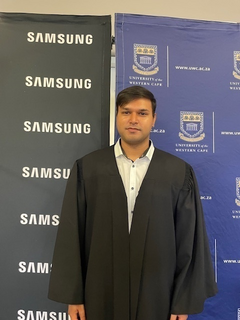 Noah Khan
The programme’s reach extends beyond the private sector. Several participants have also been working on projects with significant social impact, such as developing MzansiMed, a multilingual AI-powered tool designed in the UWC School of Pharmacy to translate medicine instructions into South Africa's 11 official languages.
This groundbreaking project, funded by the Bill and Melinda Gates Foundation and leveraging AI models like OpenAI’s GPT-4o, aims to make healthcare communication more accessible. Interns from the lab have played vital roles in refining this tool, applying their skills to solve real-world challenges in healthcare.
Earlier this month, at the 2024 certificate ceremony, prizes were also awarded to the top students.
Luke Padiachy and Buhle Mcetywa, shared the multi-platform software development award. Noah Khan received the top Digital Social Innovation Award.
The top student application awarded was PhysiLync, a highly innovative sports rehabilitation application using artificial intelligence and virtual reality to make rehab services more inclusive to schools and individuals who would normally not be able to afford the services of physiotherapy, biokinetics, and sports scientists.
Khan admitted that he was “very tech-averse” before joining the programme.
“I didn't know much about technology, and from the get-go and the first introduction when I first joined the course, I was shown that AI and technology are beautiful things that can actually change people's lives. And I think I've definitely learned a lot more, especially coming from a background that wasn't very tech, you know, we weren't a very technological family. So I think this course also gave me the opportunity to interact with tech in a way I've never ever had the opportunity to do,” said 27-year-old Khan.
The Future-Innovation Lab is preparing for its next intake, scheduled for February 2025.
This programme, open to previously disadvantaged South African youth aged 18-35 currently unemployed, provides a unique opportunity to gain critical software development skills. Interested individuals must meet the following criteria:
- Be available for full-time participation in the course (Mon to Fri, 08:30-16:30)
- Have a Matric certificate
- Be committed to working hard to become a software developer.