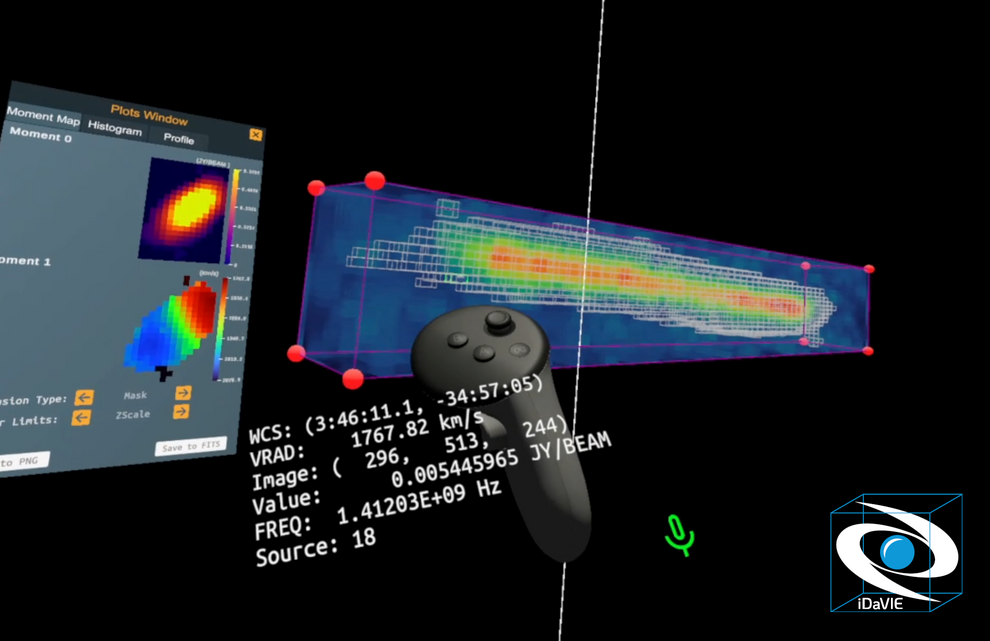
 The iDaVIE can be used to mask out galaxies from radio astronomy data
The IDIA is a partnership between UCT, the University of the Western Cape (UWC), and the University of Pretoria.
Developed by IDIA’s Visualisation Lab, iDaVIE uses Virtual Reality (VR) technology to enable users to explore massive datasets in 3D, providing an immersive experience that offers deeper insights into the cosmos and beyond.
iDaVIE, or immersive Data Visualisation Interactive Explorer, allows researchers to use VR headsets to virtually step inside their data, transforming how they interact with intricate information.
Astronomers, for instance, can explore radio data from telescopes like MeerKAT in stunning detail, opening up new ways to understand galaxies, stars and other celestial objects.
This cutting-edge software is designed to handle large data sets. It is also adaptable for various disciplines, such as medical research and engineering, making it a versatile tool for many fields.
 The iDaVIE is multidisciplinary and can be used to view an MRI (magnetic resonance imaging) scan of a brain.
With the SKA project on the horizon and MeerKAT already generating vast amounts of data, iDaVIE will help UWC’s astronomers analyse data more efficiently and collaboratively.
The department can now offer students and researchers hands-on experience with advanced data visualisation techniques, further strengthening UWC’s role in the global astronomy community.
Dr Lucia Marchetti, IDIA’s Visualisation Lab Director, said: “This tool will help researchers unlock new insights and foster collaborations globally.”
UCT and IDIA’s decision to make iDaVIE open-source will encourage more innovation and collaboration, ultimately pushing the boundaries of what’s possible in scientific research.
UWC Prof Sally Macfarlane also emphasised that tools such as iDaVIE help researchers gain a new perspective on their data, driving a deeper understanding and inspiring innovative questions through the multidimensional exploration of their data.
Questions such as these may not have been discovered through the use of more traditional and less immersive visualisation tools.
“As an outreach and education tool, iDaVIE exhibits great potential. While exploring their data in VR, researchers can relatively easily display their point of view on a larger and more public screen. Groups of researchers, students and the general public are then able to get a sense of the data exploration process (if not the full immersion) and can potentially assist in the scientific process themselves,” said Prof Macfarlane, who is also the Associate Director for Development and Outreach hosted by the Department of Physics and Astronomy at UWC.
For more information about the IDIA Visualisation Lab, visit: https://vislab.idia.ac.za/
Online documents for the iDaVIE software are available here