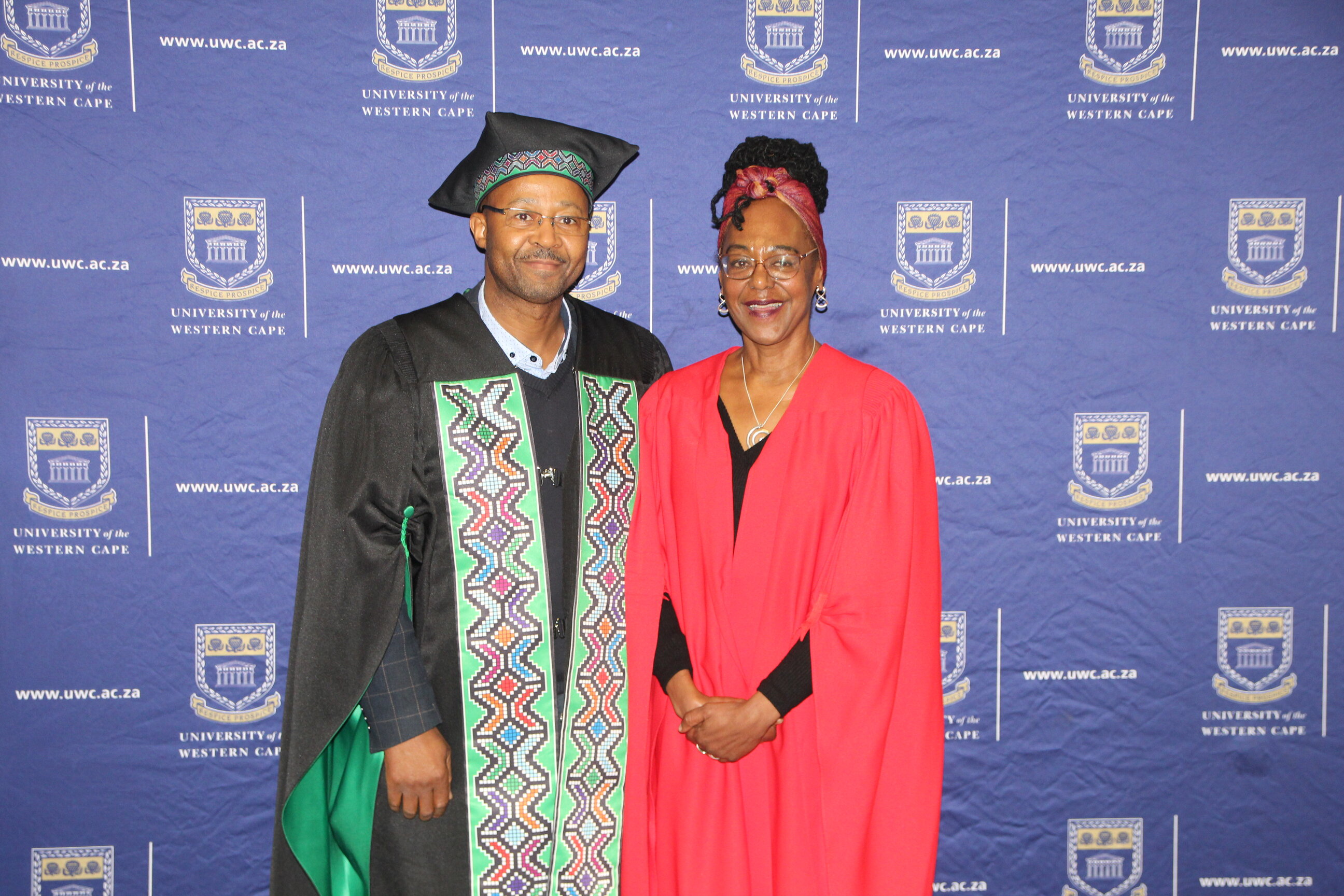
Her lecture, titled "Using Food as a Lens in Transdisciplinary Humanities: Rethinking Othering and 'Being Human'”, not only showcased her extensive knowledge of gender, feminism, and interdisciplinary food scholarship, but also offered actionable insights for both academics and individuals on paths for meaningful change.
Professor Lewis, from the Department of Women’s and Gender Studies at the University of the Western Cape (UWC), focused her research on humanities approaches to food systems.
She explored the concept of "re-story-ing" through food's connections to human subjectivity, ethical relations, and the complexities of our times.
Emphasising the need to unlearn and relearn, she examined the intersections of food, literature, domestic cooking, and the relational dynamics between humans and non-humans.
"What's been especially enriching about working in the Women's and Gender Studies department is the unlearning to learn. It's not only our undergraduate students who are urged to unlearn, for example, ideas about the ‘normal’ body,” she said.
Professor Lewis, author of "Living on a Horizon: Bessie Head and the Politics of Imagining”, structured her lecture into three parts: the need for Restory-ing, Re-storying Women's Domestic Cooking, and The Coloniality of Being and ‘Home’.
She analysed J.M. Coetzee's novel "Waiting for the Barbarians”, which explored how it challenged the narrative of human progress by contrasting the citizens of the "Empire" with the "Barbarians”.
The novel critiques the Empire's brutality and extractivism toward nature and other beings, questioning the notion of civility tied to agricultural advancement.
"Our current predicament enforces the necessity to rethink and re-examine the status of human subjectivity and the ethical relations, norms, and values that may be worthy of the complexities of our times," she said, quoting Rosi Braidotti.
Reflecting on her own memories in telling marginalised or neglected stories, Professor Lewis discussed the complexities of certain women's domestic cooking.
She highlighted how some women's culinary skills established their roles as authoritative creators and custodians of taste, influencing appetites and desires within families and communities.
She emphasised the need to recognise the agency and influence of marginalised women, in shaping tastes, cultural exchange, and relationships with the non-human world through domestic cooking.
"Critics have highlighted the social pressure on women to be 'angels in the house’, often resulting in women being facetiously dubbed 'Dr Homemaker’. I've held this feminist view for years, Anglo-American in nature, and consequently, I've ignored memories that trouble the automatic association of the domestic realm with captivity and the public sphere with agency and social recognition," she remarked.
She also explored the kitchen's spatial politics and the cooking's cooperative nature in many contexts that were different from those critiqued by traditional Anglo-American feminism.
 Professor Desiree Lewis
Going on to explore Zoe Wicomb’s novel "October”, she turned to another literary example of “worldmaking” that transcended dominant narratives of modernity.
Professor Lewis examined the central character Mercia's conflicted relationship to a sense of home through her sensory responses to food.
She contrasted the performative cosmopolitan environmentalism of this educated character with her sister-in-law’s grounded sense of connection to other people, life forms and the earth.
She therefore demonstrated this marginalised character’s capacity to imagine ways of being human that transcends stories of modernity - through her reverence for and connection to non-human beings and her environment in cooking and gardening.
Professor Lewis also raised concerns about neglecting certain forms of knowledge, such as the social, emotional, and spiritual aspects of food and eating, within dominant academic frameworks.
She challenged the insensitivity of some posthumanist scholars to transnational epistemologies and non-dualistic knowledge systems.
"Richard Nagar urges us to rethink political struggle and hunger. Drawing on years of work with Indian activists, she writes that ‘the common senses handed down to us by dominant frameworks often require re-evaluation’," she said.
In conclusion, Professor Lewis pointed out that while new materialism and critical posthumanism are celebrated as paradigm shifts in academic canons, they had been surprisingly insensitive to long-standing and diverse transnational epistemologies.
She criticised the narrow perspective of some posthumanist scholars who presented their knowledge as groundbreaking despite being rooted predominantly in traditions from the Global North and academia, and ignored knowledge and storytelling beyond the academy.