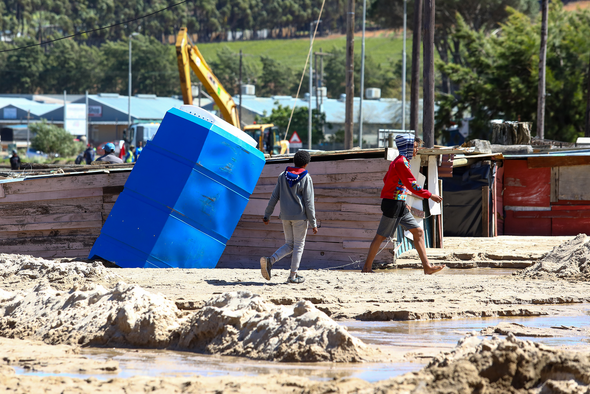
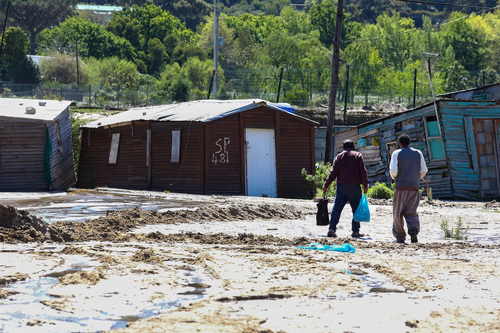
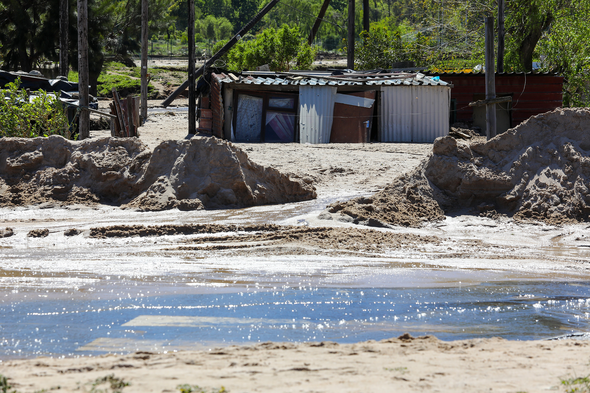
 Shacks in Sir Lowry’s Pass Village were completely covered with mud after flooding occurred in the area. (Photo: Supplied)
“We’re dealing with changing climate in particular, how this relates to human wellbeing and how this impacts ecosystems, their ecology and biodiversity that ultimately, underpins them,” said Dr Patrick O’Farrell.
He is a National Research Foundation B-rated researcher and has, for the past 22 years, worked in the fields of applied ecology, land-use planning and ecosystem services, with a focus on understanding social-ecological systems in the context of development and conservation.
“As climates change…this has massive implications for ecosystems and how they are able to respond to these drivers of change, particularly around climate. When ecosystems change, ultimately it means that humans benefit differently from them. If the functioning of an ecosystem service is compromised then we may lose the goods and service they can provide to us,” said Dr O’Farrell.
“For example, natural ecosystems provide important habitat for pollinators who pollinate our crops, our fruits and what have you,” said Dr O’Farrell.
According to the most recent report from the World Bank, South Africa is especially vulnerable to climate change given its water and food insecurity, as well as the potential impacts on health, human settlements, infrastructure and critical ecosystem services.
“Nature can only provide its benefits if it can function and if there’s enough of it around. Typically, what we see on the Cape Flats is that we have a lot of nature on the mountains where the rich live, but here we don’t have a lot.”
And because of pressure on government finances, Dr O’Farrell said the questions facing local governments in South Africa, and particularly Cape Town, are not a simple choice when striking a balance.
“It’s not easy; you can't sit here and say: ‘Ah, we need to conserve nature.’ or ‘We need to have houses’. We need all of these, we need economic opportunities. We ultimately want a city that's filled with people who see a future for themselves and can live happy, fulfilled lives. We ultimately need to think about what the system will look like, such that people can actualise their potential and live in a way that they want,” said O’Farrell.
He said local governments are very focused on economic opportunities and approve developments like the Riverlands development, which houses Amazon South Africa’s head office, as a means to grow the city’s tax base. More needs to be done in meeting broader residents' wellbeing goals aside from the economic.