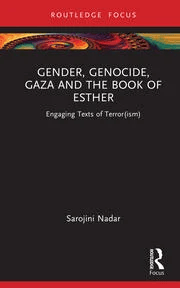
As we commemorate International Women’s Day on 8 March 2025, the much-anticipated book, Gender, Genocide, Gaza and the Book of Esther: Engaging Texts of Terror(ism), by Professor Sarojini Nadar of the University of the Western Cape, will offer a timely and critical interrogation of the intersections of gendered and geopolitical violence - both in ancient scripture and contemporary conflicts.
A globally respected scholar in feminist biblical hermeneutics, Professor Nadar brings a decolonial feminist lens to the Book of Esther, exposing the overlooked links between sexual and ethnic violence. While much scholarship has examined the potential genocide of the Jews in the text, this work turns attention to the Persian “retaliation genocide,” positioning the royal harem (where women were sequestered for the king’s use) and herem (divinely sanctioned warfare) as interwoven structures of power.
On a day dedicated to women’s rights and justice, this groundbreaking book challenges us to confront how sacred texts are mobilised to justify violence. By critically examining the modern geopolitical reception of Esther - including Israel’s invocation of the Amalekite extermination trope in October 2023 to justify attacks on Gaza - Professor Nadar compels readers to expand feminist critiques beyond sexual violence to the broader necropolitical realities shaping both past and present conflicts.
This highly anticipated work is a must-read for those committed to dismantling gendered and racialised violence. As we reflect on the struggles and triumphs of women globally, Gender, Genocide, Gaza and the Book of Esther serves as both a scholarly intervention and a call to action for justice and peace.
The book can be pre-ordered here: https://www.routledge.com/Gender-Genocide-Gaza-and-the-Book-of-Esther-Engaging-Texts-of-Terrorism/Nadar/p/book/9781032895499
The phrase “we are sisters under the skin” has often been a rallying cry for feminist solidarity, suggesting a universal womanhood that transcends race, class, gender and sexual identity, and geography. International Women’s Day (IWD), celebrated annually on 8th March and officially recognised by the United Nations in 1977, seems to affirm this idea of global sisterhood. But history - and lived experience - tell a different story. As Chandra Mohanty reminds us, “beyond sisterhood there is racism, colonialism, and imperialism.”
IWD has its roots in the socialist and workers’ movements, a history that is often overlooked in contemporary celebrations. It is a day of resistance against exploitative labour conditions, against the undervaluation of women’s work, and for economic justice. Yet the victories of women’s movements have never been evenly distributed. While some women fought for the right to work, others - especially working-class Black women - fought for the right not to be exploited by work. Some women demanded entry into professional spaces; others were trapped in the most dehumanising forms of labour.
These divisions persist. Even within institutions of higher learning, inequality is structured into the very policies that shape women’s lives. Consider parental leave and maternity benefits. Academic staff - primarily middle-class professionals - receive 6 months parental leave with ease, their salaries continuing uninterrupted.
In contrast, administrative and support staff must navigate layers of state and institutional red tape, relying on the Department of Labour and the Unemployment Insurance Fund just to secure their full salaries during maternity leave. The disparity is unmistakable: some women’s reproductive labour is prioritised over others. Motherhood is not supported equally - class and race determine whose care work is recognised, and whose is treated as an afterthought.
Patricia Hill Collins describes this as the ‘matrix of domination’ - the interlocking systems of race, gender, and class that shape women’s lives in radically different ways. This is not an abstract theory; it is an observable historical pattern. The suffrage movement, often celebrated as a victory for all women, was primarily a victory for white, middle-class women.
In South Africa, Black women’s struggle for political rights could never be separated from the broader fight against apartheid. The iconic 1956 Women’s March to the Union Buildings is often remembered as a moment of feminist unity, but at its core, it was an anti-apartheid protest. The thousands of Black women who marched that day - alongside white allies - were not only demanding gender equality; they were resisting a system that controlled every aspect of their movement, their labour, and their right to exist in certain spaces.
The pass laws determined who could work where, who could move freely, and who could even claim the most basic rights of citizenship. The struggle for economic and social mobility was dictated by race and gender, making it clear that not all victories were shared.
This history continues to structure the present. Even within feminism, these patterns of exclusion persist. The global response to sexual violence offers a stark example. After October 7, 2023, the alleged rapes (the widespread media claims were later disproven) of Israeli women were met with immediate international outcry, amplified by governments, media outlets, and human rights organisations. Yet the ongoing rape, torture, and killing of Palestinian women - documented for decades - are met with silence, denial, or justification.
This is not about weighing one form of violence against another; it is about asking why some women’s suffering is treated as urgent and undeniable, while others are rendered invisible. The pattern is as old as war itself: Black women’s suffering is always deemed collateral damage.
These dynamics of power, violence, and selective recognition are central to my forthcoming book, Gender, Genocide, Gaza, Engaging Texts of Terror(ism) in the book of Esther (Routledge, 2025). The biblical book of Esther is often interpreted as a triumphant story of a courageous woman who saves her people from a planned genocide at the hands of an eternal enemy, Amalek. This narrative was weaponised - literally - by Benjamin Netanyahu in October 2023 when he declared war on Gaza, chillingly stating, “We remember Amalek.”
Feminist scholars have long recognised the gender-based violence in the text - the forced conscription of young women into the royal harem. Yet they have largely ignored a key aspect of the story: its ethnic violence. The same narrative that acknowledges women’s subjugation under patriarchy simultaneously justifies the extermination of the “not chosen” ethnic groups under herem (divinely sanctioned genocide). My book argues that the harem and herem are not separate forces in the text; they are co-constitutive. Gendered violence does not exist in isolation from racialised violence - it reinforces it. The same logic operates in contemporary political conflicts. When feminist discourse recognises gendered oppression but remains silent on racialised violence, it becomes complicit in erasure.
International Women’s Day must become truly international - not in name only, but in its commitment to global solidarity. As bell hooks reminds us, “Women do not need to eradicate differences to feel solidarity. We do not need to share common oppression to fight equally to end oppression. We do not need anti-male sentiments to bond us together, so great is the wealth of experience, culture, and ideas we have to share with one another. We can be sisters united by shared interests and beliefs, united in our appreciation for diversity, united in our struggle to end sexist oppression, united in political solidarity.”
This means dismantling the hierarchies that determine whose struggles are recognised and whose are ignored. It means that the lives of Palestinian women - who continue to endure genocide even within a ceasefire agreement - must matter as much as the lives of Israeli women. It means that Black women’s labour, suffering, and resistance cannot remain an afterthought in feminist movements that prioritise whiteness. It means refusing the liberal impulse to proclaim that “all lives matter” when history has shown us that some lives are grieved, protected, and avenged, while others are disposable. Solidarity is not about pretending all women are the same. It is about recognising the differences that shape our struggles while refusing to let those differences divide us.
If IWD is to be more than a symbolic gesture, it must be grounded in an ethic of radical solidarity - one that refuses to separate gender from race, class and colonial violence. Otherwise, it remains a day of hollow celebration, masking the inequalities that continue to shape the world.
- Professor Sarojini Nadar holds the Desmond Tutu South African Research Chair (SARChI) in Religion and Social Justice and is currently acting as Dean in the Faculty of Arts and Humanities at the University of the Western Cape.
The University of the Western Cape has been a pioneer in South Africa of Gender Equity and Women and Gender Studies, with significant work over a span of three decades through its Gender Equity Unit and its Department of Women And Gender Studies.
Gender Equity Unit
Women and Gender concerns at the University of the Western Cape were addressed within a very specific context. In the mid-1980s, when the country was still embroiled in the liberation struggle, women and gender issues were of lesser concern than the bigger issue of human rights. However, a small group of feminists – and men supporting feminism – at the University were deeply concerned about the structural inequities that existed between women and men on campus, and set about advocating change.
These inequities included disparities in salaries between women and men; men generally earned more than women; women did not receive housing subsidies; there was no maternity leave for women; there were no promotion opportunities for women; women could not go on sabbaticals and all the professors were male with white men in the most senior professorships.
Feminists were concerned about the lack of substantive equity. Issues with regard to bodily integrity, reproductive health and safety and security were of the first items on the transformative agenda for women on campus. As one female lecturer commented: 'I practically gave birth in the classroom.' During the mid-eighties the then Rector, Jakes Gerwel, was approached by women staff to address their equity concerns. Subsequently a Women's Commission was formed in the late eighties that drew up a list of discriminatory practices and proposals to address them and submitted it to the Rector, Senate and Council.
The list included issues around maternity benefits, housing subsidy, childcare facilities, a sexual harassment policy and the safety for women on campus. Systematically, public presentations were made and gains were achieved. The University management was compelled to become more supportive and gender-sensitive in their dealings with women. Women's concerns became part of the broad political social transformative discourse at the University.
In 1993, the Gender Equity Unit was formally established and the first Gender Equity Coordinator, Rhoda Kadalie, was appointed. The Unit was established with seed funding from the Ford Foundation. It was realised that the broader national liberation movement under the auspices of the Mass Democratic Movement did not include the liberation of women. The denial of women's liberation was acutely felt on campus as many of these activist organisations were based at the University of the Western Cape during the height of apartheid. Many of the women on campus were also involved in the United Women's Congress, the African National Congress Women's League and the United Democratic Front. There was therefore a keen political awareness of the marginalisation of women's concerns. The University is well known as a site of struggle against the apartheid regime.
Women students on campus were also particularly aware of the oppression of women. Collette Solomons, an anthropology honours student, submitted a mini thesis: 'Sexism at the University of the Western Cape: with reference to progressive student organisations'. This thesis evoked strong debates because it focused on issues of rape and harassment amongst the student population on campus, and it challenged the notion of justice and respect for women students.
Women students demanded that gender justice be included in the quest for democracy in the students' struggle for freedom.
The pressure for the University to become inclusive of women's rights as human rights came from both the students and staff. The Gender Equity Unit staff started to hold countless public debates, forced the student disciplinary committees to change, conducted awareness raising workshops, educated and trained student leadership, and hosted extensive conscientising programmes in the residences to transform the gender hostile climate on campus.
By the mid-nineties the University of the Western Cape had the best maternity benefits in the country - five months fully-paid leave and seven days paternity leave for men; housing subsidies for married women; chief invigilation duties for women; and an educare centre for children of staff. The unit also developed a Sexual Harassment Policy; a Gender Policy and a Non-Sexist Language Policy. Resource booklets on sexual harassment were developed and distributed. Ad hominem promotion was granted to women academics, and for the first time they had equitable access to study leave and research funding. A Women's and Gender Studies Programme was also established.
Women students formed a volunteer group called Kopanang and began to raise gender awareness amongst students. UWC became the centre for raising awareness on women and gender rights in the country, well in advance of the post-apartheid liberal language framework and rhetoric.
For more on the Gender Equity Unit visit: campus-life/special-units-and-programmes/gender-equity-unit
Department of Women and Gender Studies
The Women’s and Gender Studies (WGS) Department is an inter- and trans-disciplinary department that offers undergraduate and postgraduate programmes and engages in a wide range of collaborative research projects with local and international partners towards intersectional gender justice.
WATCH: What is the Department of Women and Gender Studies at UWC
For more information on the Gender Equity Unit, visit: study/all-areas-of-study/departments/department-of-women-and-gender-studies/overview